Driveways
Block paving, tarmac or gravel: choosing a driveway surface
The honest trade-offs between the main driveway surfaces — and the part of the job that matters more than the surface you pick.
18 August 2026 · 5 min read
Most people choose a driveway by looking at surfaces. It is worth knowing before you start that the surface is the part you can see, and the part underneath is the part that decides whether it still looks like that in ten years.
What is underneath matters more than what is on top
Every driveway we build starts the same way, whichever finish goes on it: dig out to a proper depth, build up a compacted sub-base, sort the edges so the surface has something to hold it in, and work out where the water is going. A beautiful block-paved drive on an inadequate base will sink and rut. A modest gravel drive on a good base will still be flat years later.
If you are comparing quotes, this is the part worth asking about. Two prices for "the same" driveway are often quoting two quite different amounts of groundwork.
Block paving
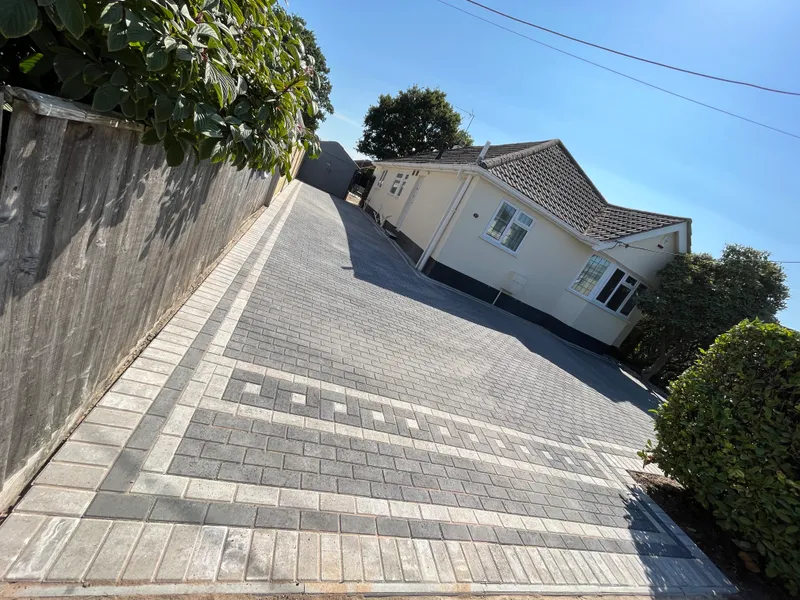
Block paving gives you the widest choice of colours, patterns and borders, and it has one practical advantage the others do not: if a section is damaged or you need access to something underneath, individual blocks can be lifted and put back. It is the most decorative option and it suits period and modern houses alike.
It asks for a little upkeep — the jointing sand needs topping up occasionally, and it will want cleaning and re-sanding every few years to stay sharp. As a Brett Approved Installer we fit Brett's paving products, which means the materials and the standard of installation are ones the manufacturer is prepared to put their name to.
Tarmac
Tarmac gives you a clean, continuous surface with no joints, and it goes down quickly. It suits longer drives particularly well, where block paving can start to feel busy and the cost climbs with the area. It is comfortable underfoot and easy to keep clean.
The trade-off is that repairs are more visible — a patch will not disappear the way a replaced block does — and the colour range is limited. A block-paved border is a common way to lift it.
Gravel and bonded aggregate
Loose gravel is the most cost-effective way to cover an area, drains freely, and has a security benefit people often overlook: you can hear someone walking on it. The downsides are that it migrates, particularly on a slope, and it needs edging and occasional raking to stay tidy.
Bonded aggregate — where the stone is bound into a solid surface — keeps the look of gravel without the migration, and gives you a smooth surface for pushchairs, wheelchairs and bins. It costs more than loose gravel and less than most block paving.
Concrete
Concrete is hard-wearing, low-maintenance, and works well where you want a plain, practical surface. Laid with proper joints it copes with heavy use, and it can be finished in various textures if you would rather it did not read as plain grey.
Drainage is not optional
Since planning rules changed, front gardens generally need a driveway that either uses a permeable surface or directs water somewhere it can soak away, rather than running it off into the road. It is worth raising early, because it can influence which surface makes the most sense for your property. It is a question we will cover when we come out.
We build driveways across Poole, Bournemouth and Christchurch in all of these surfaces, and if your existing drive only needs cleaning, re-sanding and sealing rather than replacing, we will say so. Estimates are free and no-obligation.